
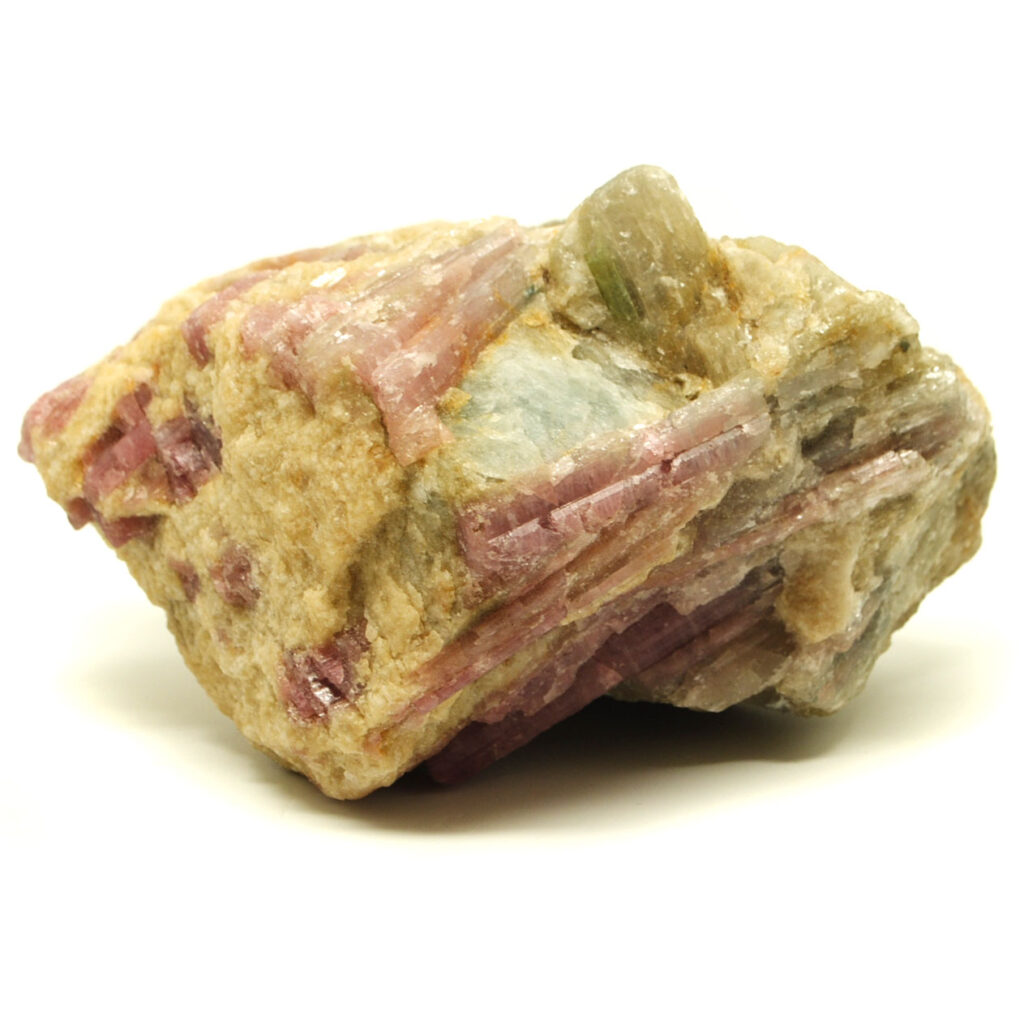
Pink Tourmaline with Aquamarine in Quartz
$ 96.86
Quartz The colorless, transparent variety of quartz. Quartz is composed of silicon dioxide, the most common mineral in Earth’s crust after ice and feldspar. The name “rock crystal” emerged in the Middle Ages to differentiate it from colorless glass. The Greeks called water-color crystals krystalos, hence the name “crystal.” The name quartz comes from Old German, but its origins are unknown. Metaphysically, quartz is used for power, communication, and cleansing. Found worldwide, fine specimens of quartz can be found in Arkansas, Brazil, and Madagascar. Aquamarine Birthstone for March Meaning “sea water,” aquamarine is the light green to blue variety of the mineral beryl. Its ocean hues come from traces of iron. Aquamarine is almost always found in cavities in pegmatites or in alluvial deposits, and forms larger and clearer crystals than its cousin, emerald. One crystal found in Brazil weighed 245 lbs. Vikings wore aquamarine for protection on their long sea voyages. Today, aquamarine is used to bring peace and calm to its user. Fine specimens of aquamarine are found in Afghanistan, Brazil, USA, and Pakistan. Tourmaline Alternate October Birthstone (pink tourmaline) Tourmaline is a crystal silicate mineral with the broadest color palette of any mineral group. The name derives from the Sinhalese turmali, meaning many-colored gems. Bi-colored and multicolored crystals are common, reflecting variations of fluid chemistry during crystallization. Each color has its own mineral name, including rubellite (red, pink), indicolite (blue), verdelite (green), and schorl (black). Tourmaline is found in Sri Lanka, Brazil, and California. Metaphysically, schorl is good for protection, rubellite applies to matters of the heart, verdelite helps with prosperity, and indicolite aids with intuition.
Related products
-
The Undertaker Autographed/Signed WWE 16×20 Photo BeckettAdd to cart
-
Ray Mancini Autographed Everlast Red Right Handed Boxing Glove BeckettSelect options
This product has multiple variants. The options may be chosen on the product page
-
Larry Holmes Autographed/Signed Black Left Boxing Glove BeckettSelect options
This product has multiple variants. The options may be chosen on the product page
-
Mike Tyson Autographed/Signed Black Left Handed Boxing Glove BeckettSelect options
This product has multiple variants. The options may be chosen on the product page