
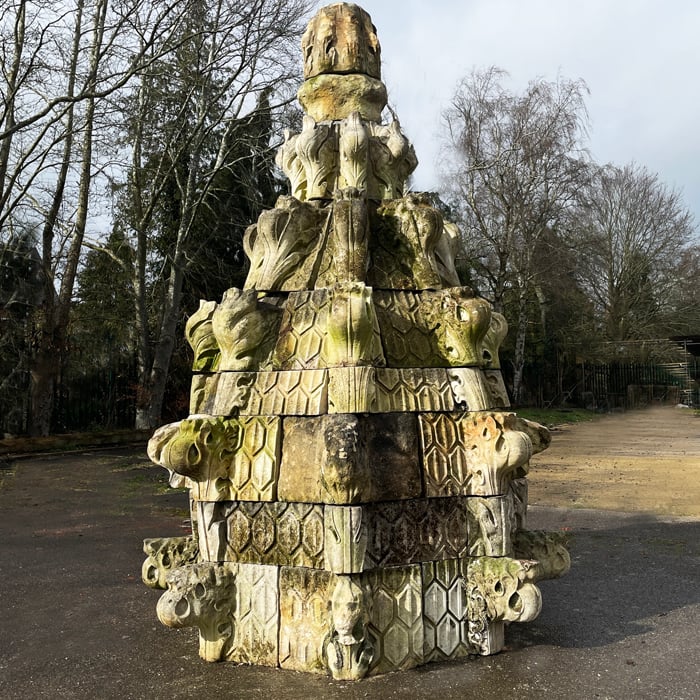
Palace of Westminster: A Victorian Anston and Portland stone crocketed spire
$ 91.43
We have salvaged carved elements of the Palace of Westminster before – for reasons that will become clear below. But we have never got our hands on an entire spire. It is an almost unique opportunity to acquire an iconic piece of Architectural Salvage that will make a fabulous focus-piece in any garden, park or courtyard. The Palace of Westminster needs little introduction. Following a catastrophic fire in 1834, that completely destroyed the previous Parliament buildings, a complex which had evolved over hundreds of years, Architects were invited to submit plans ‘in the Gothic or Elizabethan style’ for their entire replacement. Ninety-seven designs were submitted, with authorship hidden from the judges, and of these Charles Barry’s was selected. The Encyclopaedia of London summarises the story well: “Charles Barry, knighted in 1852, son of a prosperous stationer, was born in Westminster and had been articled to a firm of surveyors in Lambeth. With a modest inheritance from his father he travelled in Italy, Greece and Turkey and became deeply influenced by Renaissance architecture. [Having won the competition and being…]conscious of his limitations as an architect in the Gothic style, he enlisted the help of Augustus Welby Pugin who had been trained in the office of his father, the French architect, Auguste Pugin. He had spent much of his apprenticeship in making drawings for his father’s books on Gothic architecture. Barry and Pugin made a perfect partnership. Barry providing the practical and commanding plans, Pugin the picturesque ornamentation. Construction began in 1837, Mrs Barry having the honour of laying the foundation stone in 1840. In 1847 the House of Lords was opened; in 1851 the House of Commons. The Clock Tower was not finished until 1858.” “When the Victoria Tower was [finally] roofed in 1860, and the Palace of Westminster was completed it was generally acclaimed as a building worthy to be the Houses of Parliament, and a splendid example of Perpendicular Gothic.” It is an iconic building and with its roofline encrusted with crocketed spires – of which this is one – and with The Victoria Tower at the south end and the Elizabeth Tower housing “Big Ben” to the north it is recognised around the world. However, even only after a few years of its opening, the new Palace of Westminster had a problem: the carved stone was falling apart. Chunks had an alarming habit of falling – crashing on the the terraces and walkways below. The story is taken up by Parliament’s own website: “The Palace of Westminster was built using a sand-coloured limestone from the Anston Quarry in South Yorkshire. In 1839, a committee including… Charles Barry, two leading geologists and a stone carver toured Great Britain looking at quarries and buildings. Stone from Bolsover Moor in Derbyshire was selected as first choice from 102 stones, and it was used for the lower 4 or 5 meters of stone walls on the river front. The stone was not used beyond this height because it was considered not up to standard, and stone from nearby quarries around Mansfield Woodhouse in Nottinghamshire was used instead. This stone was mainly available in thinly bedded courses and not enough was available for such a large building, so Anston was used instead.” The 102 stone samples they brought back from their tour are today held at The Natural History Museum – they formed the originating collection of “Building Stone” in the Geology Dept. Unfortunately, … “the selected Anston soon began to decay as a result of atmospheric pollution from coal burning in London, a lack of weathering at the quarry, and sometimes from the laying of the blocks without maintaining their natural bedding plane. Although defects in the stonework were visible as early as 1849, very little was done to prevent its decline during the 19th century. Barry himself experimented with various compositions on the stone and believed that the decay had been halted. During the 1920s, it was clear that something had to be done, especially when a large fragment fell off the Victoria Tower; members on the Terrace were advised to sit near the river thereafter, rather than underneath the main wall of the building. In 1928, it was deemed necessary to use Clipsham stone, a honey-coloured limestone from the Medwells Quarry in Rutland, to replace the decayed Anston. A restoration project began in the 1930s, but it was brought to a halt during the Second World War and was completed only in 1960.” Restorations to the Place of Westminster in the 1930’s. Nb. The handrail to the balustrade of Westminster Bridge is seen – part of the entire balustrade of the bridge sold by LASSCO Three Pigeons last year. In the meantime, the Luftwaffe had scored eleven direct hits during the Blitz. The worst was an incendiary bomb that landed in the Commons chamber on the 11th May 1941 causing serious damage. The rubble and charred timbers were carted away to a yard near Finsbury Park. The Commons chamber was restored after the war with much of Pugin’s interior decorations lost – restorations to the exterior stonework continued. “The effects of these repair works and the addition of new stone nevertheless began to make the Palace appear like a patchwork quilt. By the 1960s, questions about it were being asked in the House of Commons. By the 1970s, the effects of pollution were again visible, and a new programme of stone-cleaning and restoration was started in 1981: the north, west, and south fronts, the river front and the Clock Tower were completed by 1986. The Victoria Tower, whose cleaning was completed in 1994, was the last part of the exterior to be dealt with. Of the inner courts, the Speaker’s Court was the first to be tackled, with the work beginning in January 1994.” The spire now standing in the yard at LASSCO Three Pigeons was one of two that were salvaged during one of these phases of restoration. They changed hands on number of occasions but were not re-built – remaining on pallets for decades and ended up in a garden in Cambridgeshire. The photographs show our first attempt at building it – a jigsaw without a picture on the box. Now we have regained the basic form we will disassemble it and try and decipher the mason’s marks in order we can improve on it and re-build it tighter and with fewer idiosyncracies! It can be delivered on about 10pallets.
Related products
-
Meal Carrier (16 Slot, Insulated, Thermostat)Add to cart
-
Lowerator Heated Plate Warmer, 36″Select options
This product has multiple variants. The options may be chosen on the product page
-
Meal Carrier (5 Slot, Insulated)Select options
This product has multiple variants. The options may be chosen on the product page
-
Meal Carrier (6 Slot, Insulated)Select options
This product has multiple variants. The options may be chosen on the product page