
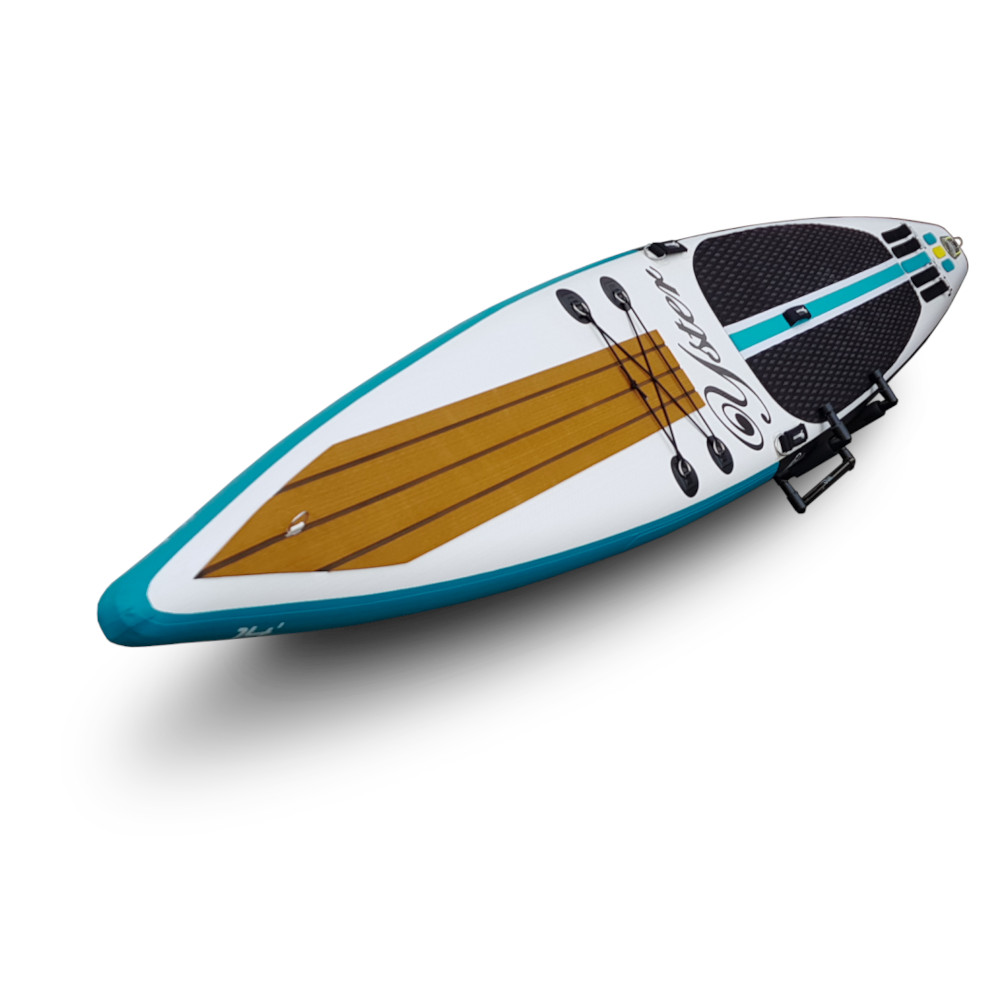
Yster ISUP 14’x 25″ Linear
$ 92.70
Description ISUP 14’x 25″ Linear Go to races you never been to before. Leave your hard board back home and bring your Yster ISUP 14’x 25″ Linear to national and international SUP races without compromising on performance. Yster ISUP 14’x 25″ Linear can be inflated to 26 psi and has a maximum technical pressure of 30 psi. In addition, rail stringers run along the sides of the board to further increase the rigidness of the board longitudinally. The tracker fin in the nose provides directional stability also in crosswinds. The raised kick tail comes in handy in SUP races with technical disciplines and the extra handles are perfectly positioned for beach starts. IN THE BOX: Inflatable SUP 14’x 25” Professional Yster wheeled backpack in strong 1680D Nylon with integrated changing mat. GRI Double Action SUP-pump with pressure gauge. Single center 9” flat water fin Repair kit with repair patches and valve key TECHNICAL SPECIFICATION: Design: Fusion Dropstitch and standard US fin box. Length: 14′ (427 cm) Width: 25” (63.5 cm) Height: 6” (15 cm) Weight: est 10 kg Recommended pressure normal usage: 20 psi Maximum inflation pressure: 26 psi Maximum technical pressure: 30 psi Characteristics Phenomenal glide Flat rocker The board is designed with a camber like that of cross-country skis. This helps distribute the paddler’s weight across the entire length of the board, achieving a flat rocker that utilises the full waterline, providing excellent glide with minimal deceleration after each paddle stroke. Extremely rigid Integrated rail stringers in Dyneema® The integrated rail stringers in the low-elongation polymer Dyneema® that run along the sides make the board extremely rigid longitudinally. Straight line tracking Nose fin The nose fin and the low rocker give Yster ISUP 14’x 25″ Linear a phenomenal directional stability. High dynamic stability Square tail The square tail increases stability when you have speed in the water. Hard and rigid High pressure Yster ISUP 14’x 25″ Linear can be inflated to 26 psi, which makes it rigid so that it does not sag in the middle. Secure the nose D-ring in the nose Secure the nose of the board with a tie down when transporting it on the car roof. Wear a front leash D-ring for front leash Depending on your stance, you can choose to attach the leash to one of the front D-rings. Place for a water bottle Front packing straps The front packing straps are perfectly positioned for having a water bottle within reach. A firm grip Neoprene handle The comfortable handle in neoprene gives a firm grip of the board. . Extra handles in just the right place Beach start handle The extra beach start handles are positioned so that the board can easily be pulled out of the water. Solid grip under the back foot Dual tail pads Tail pads are positioned so that both lighter and heavier paddlers will get a solid grip under the back foot during pivot turns. Grip in all directions Diamond patterned pad The pattern of the pad gives excellent grip in all directions whether you paddle barefooted or with shoes. Directional stability Directional stability means how straight the board tracks in the water. In addition to the shape of the board, directional stability are also affected by e.g. wind, waves, currents, fin design and fin positioning, paddler’s position on the board and paddling technique. Glide Glide means how effortlessly the board moves in the water. In general, the longer and slimmer board, the better glide, but the shape and rocker of the board also has a great impact on the water flow characteristics. Other factors that affect the speed of the board are wind, waves, currents, fins, paddler’s positioning on the board and paddling technique. Stability Stability indicates how stable the board is to stand and paddle on. The static stability, i.e. when standing still on the board, is in essence affected by its width, bottom profile and fin size. The dynamic stability – when the boards travels in the water – is also affected by its width, bottom profile and fin size but also by the shape of the tail. As a result, Yster’s boards feel more stable, even though they are long and narrow. Other external factors that affect the perceived stability are wind, waves, currents, fins and paddler’s positioning on the board. The number gives an relative indication of the weight of the characteristics.
Related products
-
The Undertaker Autographed/Signed WWE 16×20 Photo BeckettAdd to cart
-
Ray Mancini Autographed Everlast Red Right Handed Boxing Glove BeckettSelect options
This product has multiple variants. The options may be chosen on the product page
-
Mike Tyson Autographed/Signed Black Left Handed Boxing Glove BeckettSelect options
This product has multiple variants. The options may be chosen on the product page
-
Buster Douglas Autographed/Signed Red Left Boxing Glove Insc. BeckettSelect options
This product has multiple variants. The options may be chosen on the product page